During the six months I’ve been in Limpopo, I’ve met some wonderful farmers and farm managers. Farming often operates on narrow profit margins, and an increase in the cost of fertilizer or diesel—or crop losses from insects, weather, or wildlife—can become financially devastating.
Lately, I’ve been spending time with citrus farmers who are using a variety of strategies to reduce crop losses. Most employ crop guards whose job is to chase wildlife out of the orchards. They use catapults, slingshots, long strips of black plastic that they slap against the ground, and blood-curdling shouts to scare animals away. I’m co-supervising two students, and one is studying how effective these guards are at repelling wildlife. It’s an important question because farmers spend millions of rand each year on this form of crop protection.
Just as crop guards are essential to farmers, field assistants are essential to researchers. Depending on the type of research you do, you can find yourself in the middle of nowhere and that’s not somewhere you want to be alone. Fieldwork comes with risks. You can twist an ankle, fall, be bitten by a snake, or even encounter dangerous wildlife.
So far, I’ve worked with five field assistants on this project, and each brings different strengths. Three speak local languages, two are young and energetic, one has extensive experience walking transects, and another is a certified professional hunter. Much of the land I survey contains wildlife, which is, after all, why I’m searching for baboons there. Some properties are also home to “dangerous animals” like buffalo, elephants, and lions. On those surveys, I’m especially grateful for the field assistant with hunting experience. I know very little about hunting, so I learned a great deal the first morning we worked together. Fortunately, I’ve only crossed paths with elephants. We gave them some space and they continued on their way.
Another thing I’ve learned is that South Africa has an incredible amount of fencing. I thought Texas had a lot of fences, but Limpopo is giving Texas a serious run for its money. There are low barbed-wire fences, towering game fences, electric fences, and electric fences topped with concertina wire. Over the past two months, I’ve climbed more fences than I care to count. As it turns out, I’m not the only one.
Fences define boundaries, keep wildlife in, keep people out, and generally restrict movement. They also fragment habitat, although not every species is affected in the same way. Slow-moving animals such as tortoises and pangolins may touch the bottom electrified wire, freeze, and can die from repeated shocks. Domestic animals like cattle, sheep, and goats quickly learn to avoid electric fences.
Baboons, however, seem to view fences as a challenge.
A colleague who works at a primate sanctuary jokes that there should be a Baboon Olympics because of the incredible distances they can leap. They’ll climb trees and jump over fences or use branches leaning against a fence to bypass the electricity. Many people have also told me that older baboons throw younger ones onto fences to test whether they’re electrified. I’ve never witnessed this myself, so I can’t say whether it’s true, but I’ve certainly heard the story more than once.
What I do know is that fences alone don’t stop baboons from reaching tasty oranges, tomatoes, or macadamia nuts. Increasingly, farmers are combining fencing with crop guards and dogs. It will be fascinating to see which combinations prove most effective.
Last week, I experienced another side of fencing.
After my field assistant and I finished surveying a farm, we were stopped by a man grading the road. He waved frantically and began speaking to me in Afrikaans. Unfortunately, my Afrikaans is still terrible, but he also spoke Venda and explained to my field assistant that there was a “tiger” just up the road. He wondered whether I knew who it belonged to.
A tiger? I remember thinking. Is this guy confused? There aren’t any tigers in South Africa.
We drove slowly up the gravel road, and then I saw it.
A magnificent male leopard was tangled in a fence.
Wire was wrapped tightly around one of his back legs, and he was panting heavily while desperately trying to free himself. I called a friend, who called another friend, who finally reached a veterinarian. He was two hours away but immediately headed toward the farm.
As we waited, more people stopped. Everyone wondered how the leopard had become trapped and hoped the vet would arrive soon.
Eventually, he did, accompanied by five interns. They darted the leopard and waited for the ketamine to take effect. Once the animal was safely sedated, the vet discovered that the leopard wasn’t actually caught by the fence itself. A wire snare was tightly wrapped around his thigh, and the snare had become entangled in the fence. The snare was removed, and the leopard was carefully rolled onto a heavy-duty extraction tarp. At the veterinarian’s instruction, the interns and nearby farmers lifted the leopard into the back of the bakkie, covered his eyes, tucked his long body safely inside, closed the tailgate, and sped away.
I hoped he would recover but sadly, he didn’t.
Fieldwork can be physically exhausting and, at times, emotionally heartbreaking. But it is also made easier by generous farmers, dedicated field assistants, and the many people willing to stop what they’re doing to help both a wild animal and a researcher in need.
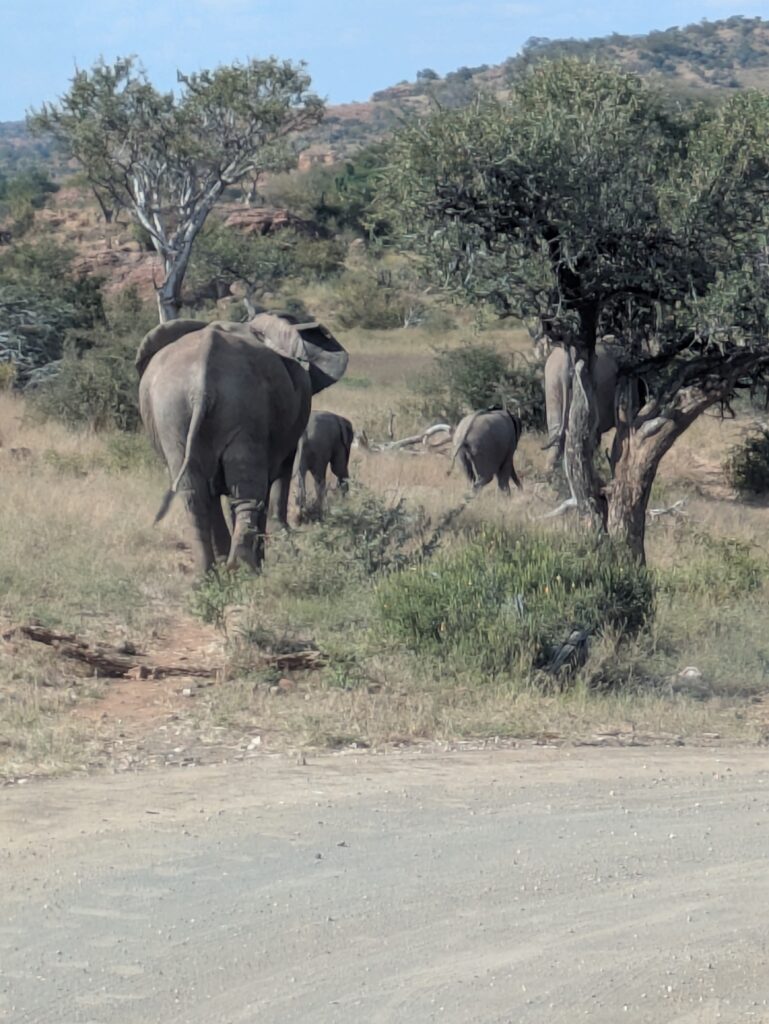
Elephants in Mapungubwe National Park
3 Comments
Joseph Fulco · July 4, 2026 at 10:31 am
You have been quite busy, Paula! Appears even in their struggles to sustain crops, the farmers are resilient. The field assistants are essential to your work. Baboons appear to enjoy the challenge of the fences…interesting. It’s survival of the fittest. So sorry to hear about the fate of the tiger.
Please remain safe and use all precautions while you continue your studies. We look forward to your next post, Paula! Btw – love the picture of the elephants!
Tara Lumpkin · July 4, 2026 at 4:07 pm
What an amazing story, Paula. How sad that the leopard didn’t make it.
And it’s interesting to learn that South Africa has more fences than Texas! If only people could work together to remove fence lines to arrest habitat fragmentation for wildlife.
We need to start seeing ourselves as part of nature, not above it. However, as long as we embrace capitalism based on the free labor of nature and non-human species and on the free labor of many humans such as women too, I fear we will continue to spiral down into further environmental degradation and destruction.
I’m thankful that you and your team are out in the field making a difference. I hope you and your team write a story for VoicesForBiodiversity.org
Jenny Knight · July 9, 2026 at 12:27 am
Oh my! I don’t know if my heart would be strong enough to do that work, Paula! Just reading first about the older baboons throwing the little ones at the electric fences and then about the leopard dying is so hard! I’m thankful that the leopard did not die alone from thirst/hunger or from another predator.